
Content Published 2018
Finding and correcting errors in company master data
Master data — the lists of names and addresses of suppliers, customers, agents and collaborators — are among the most consulted records in a company, and among the most likely to contain errors, above all in the city and province attributed to an address. Artificial intelligence can compare them against the official registers and clean them.
By Gabriele Sirtori
In the administration of a company one element is certainly the most consulted of all: master data — the lists of names and addresses of suppliers, customers, agents and collaborators. It is an almost taken-for-granted tool, blindly relied upon. How should one react, then, to the fact that more than 90% of companies report having inaccurate master data?
One of the most widespread problems in companies
The problems can be many, but the most frequent — and perhaps the most trivial — is the one linked to the incorrect attribution of the city and province of an address. This is due to the speed with which Italy’s administrative division of the territory changes: mergers of provinces and municipalities, the creation or abolition of new bodies, the creation of metropolitan cities. These are only some of the administrative changes that require the addresses in one’s master data to be updated.
The problem is serious because it is not noticed immediately: it settles over time. It comes to light only when, cross-referencing out-of-date data with more recent data, no match is found and the analyses are consequently distorted. The error is often noticed only after years, and this can lead to serious errors of judgement when managerial choices are made, to possible problems with shipments and invoicing, and to nullifying the effects of corporate CRM (customer relationship management) policies.
The problem can be solved in the classic way, by periodically consulting and correcting each entry of these lists one by one while at the same time looking on the internet for recent updates of the territorial bodies. Feasible — were it not for the fact that corporate master data often contain thousands of entries. There is, however, a faster solution: algorithms based on artificial intelligence can, in a matter of moments, compare corporate master data with the entries in the official lists and administrative registers deposited in the business-register databases, of ISTAT, INAIL, the various ministries and the public Register of Companies, so as to correct the errors present automatically. This operation is technically called data cleansing, or data cleaning — “cleaning of the data”. It is carried out in a very short time and in a completely automatic way.
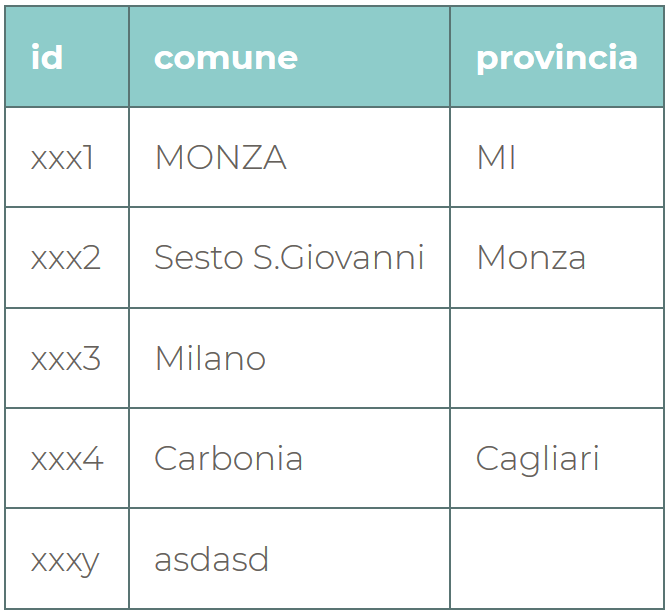
Sending a list of master data of this kind produces, in a short time, a result updated according to the most recent official data.
Figure: the same list after cleansing, with the city and province attribution corrected.
As the example shows, Monza — after having been for many years a city in the province of Milan — has since 2004 been the capital of the “province of Monza and Brianza (MB)”. In the same way the province of Milan was replaced in 2015 by the wording “metropolitan city of Milan”. Untidy, “dirty” master data can create problems with shipments and invoicing, but above all they strongly limit the possibility of exploiting the data available for market research, or of integrating it with other databases: inconsistencies inevitably arise that slow down and complicate processes.
For more information, see the EZClassifier page.